
WELCOME BONUS 300%
UP TO €2000 + 100
FREE SPINS
UP TO €2000 + 100
FREE SPINS
Home → Games
Casino games at Thunderpick
Read Statistics of Last 500 Rounds Correctly
The theoretical Return to Player (RTP) for European Roulette is 97.30%, meaning the house edge stands at 2.70% over an extended period. This figure is derived from the 37 sectors on the wheel, including a single zero, with standard payouts such as 35:1 for a straight bet. Understanding this fundamental statistic is crucial for assessing the mathematical fairness of a game.
In contrast, American Roulette, featuring an additional '00' sector, presents a lower RTP of 94.74%, resulting in a higher house edge of 5.26%. This difference directly impacts player outcomes over time, making European Roulette statistically more favourable due to its single zero. The payouts remain identical to European Roulette, but the doubled house edge is a significant factor.
Craps offers a unique 'Free Odds' bet with a theoretical RTP of 100.00% on the odds portion, equating to a 0.00% house advantage. This bet is only available in conjunction with a Pass Line bet after a point has been established. The combined RTP for Pass Line and 3-4-5x Odds is 99.63%, with a minuscule house edge of 0.37%.
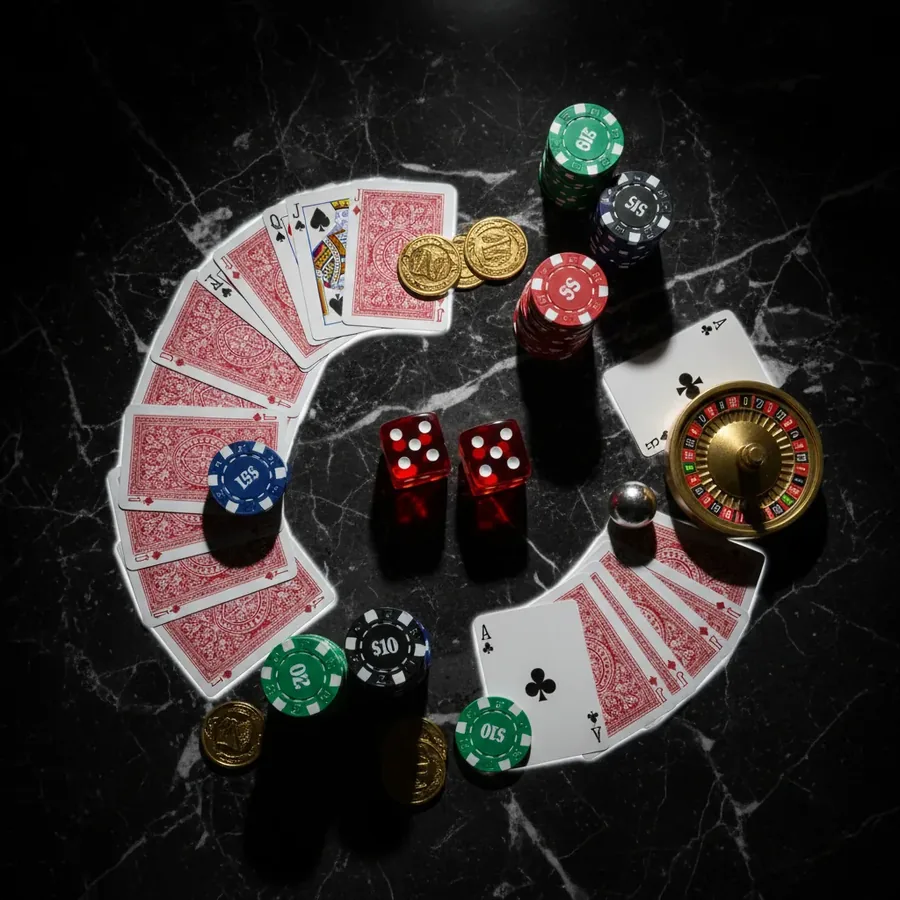
Craps: Pass Line plus Odds lowers the average
The Pass Line bet in Craps has a Return to Player (RTP) of 99.63% when combined with a 3-4-5x Odds bet, establishing a house edge of just 0.37%. This combination is significantly more favourable than many other casino offerings, making it a popular choice for players seeking lower house advantages. The odds bet pays out according to true odds after a point is set.
For instance, if a point of 4 or 10 is established, the odds bet pays 2:1. If the point is 5 or 9, the odds pay 3:2, and for a point of 6 or 8, the odds are 6:5. These payouts are based on the actual probability of the dice roll, not a predetermined casino margin.
This structure means that the more players bet on the Free Odds portion, the lower the overall house edge becomes for the combined Pass Line and Odds bet. The theoretical RTP on the Free Odds bet itself is 100%, offering a mathematically neutral outcome on that specific wager.
Split, Double, and Surrender: Three Decisions Explained
In Blackjack with liberal rules, such as standing on Soft 17 (S17), Double After Split (DAS), and Resplitting, the Return to Player (RTP) can reach 99.72%, yielding a low house edge of 0.28%. These favourable rules significantly enhance the player's statistical advantage compared to standard variations. The game also allows for Late Surrender, providing an additional option for players.
The option to Split pairs allows players to turn one hand into two, potentially improving their chances of winning, especially with favourable starting hands like Aces or eights. Doubling Down on a hand provides an opportunity to double the bet after the first two cards, typically when the hand total is strong, such as 10 or 11.
Surrender, specifically Late Surrender, offers a player the ability to forfeit half of their bet after the dealer checks for Blackjack. This is a strategic decision usually made when the player's hand is very weak, and the dealer's upcard indicates a high probability of them having a strong hand. These actions are integral to basic strategy in Blackjack.
Player pays 1:1 without any commission
In Baccarat, the Player bet offers a Return to Player (RTP) of 98.76%, resulting in a house edge of 1.24% per hand. This bet pays out at 1:1 and does not incur any commission on winnings, making it a straightforward and frequently chosen option. The standard deviation for this bet is 0.95.
While the Player bet is attractive due to its commission-free nature, the Banker bet, despite a 5% commission on winnings, provides a slightly better RTP of 98.94% and a lower house edge of 1.06%. The commission is applied to the net winnings from the Banker bet, effectively reducing its payout ratio. The standard deviation for the Banker bet is 0.93.
The Tie bet in Baccarat, however, presents a significantly higher house edge. With a payout of 9:1, its RTP is 95.16%, leading to a 4.84% house advantage, which is considerably worse than either the Player or Banker bets. This difference highlights the importance of choosing the correct bet within the game.
100 EUR bet, 50 rounds: the expected value
When placing a 100 EUR bet across 50 rounds on a game with a 97.30% RTP, such as European Roulette, the theoretical expected loss would be calculated based on the house edge. The house edge for European Roulette is 2.70%, meaning on average, 2.70 EUR of every 100 EUR wagered is retained by the casino.
Over 50 rounds with a 100 EUR bet each, the total wagered amount is 5,000 EUR (50 rounds x 100 EUR). The expected value, representing the average amount a player can expect to lose, would be 135 EUR (5,000 EUR x 2.70%). This is a long-term statistical average and not a guarantee for a specific session.
Conversely, a game like Blackjack with a liberal rule set and an RTP of 99.72% would have a significantly lower expected loss. For the same 5,000 EUR wagered, the expected loss would only be 13.50 EUR (5,000 EUR x 0.28%), demonstrating the impact of game choice and rules on potential outcomes.
Game categories at a glance
| Category | Examples | Stakes From | Highlight |
|---|---|---|---|
| Slots | The Dog House, Nitropolis 4, Gonzo's Quest Megaways | 0,10 EUR | thousands of titles |
| Table games | Roulette, Blackjack, Baccarat | 0,50 EUR | classic rules |
| Live casino | PowerUP Roulette, Quantum Blackjack Plus Live | 0,20 EUR | real dealers |
| Jackpot games | Mega Moolah, Divine Fortune, Age of the Gods | 0,20 EUR | progressive pools |
| Instant games | Aviator, Plinko, Mines | 0,10 EUR | fast rounds |
| Video poker | Jacks or Better, Deuces Wild | 0,25 EUR | strategy based |
Submit documents no older than three months
Player verification requires submitting documents that are no older than three months. This standard practice ensures the validity of identification presented during the account review process. For instance, a utility bill, which typically shows an address, serves this purpose effectively. Failure to provide current documentation can lead to delays in processing.
This requirement is a common procedure across regulated online platforms to prevent fraudulent activities and maintain compliance with anti-money laundering directives. Documents such as a recent bank statement or a government-issued ID are acceptable forms of verification. Adhering to this timeframe is crucial for a smooth onboarding experience.
The need for up-to-date documents means that players cannot reuse older versions of their identification or proof of address. Therefore, when requesting a payout or undergoing initial verification, players must ensure they have readily available recent records. This measure safeguards both the player and the platform by confirming current residency and identity.
Martingale Fails After 8 Rounds at Table Limit
The Martingale betting strategy, involving doubling the stake after each loss, can quickly encounter table limits. For example, a player starting with a €10 bet might reach a €5,000 table limit after just eight consecutive losses. This progression highlights the inherent risk of the system when faced with finite betting capacities.
This scenario illustrates how a progressive betting system can be unsustainable, even with a seemingly low number of losses. The cumulative stake in a Martingale progression can escalate rapidly; after 8 rounds, the total theoretical wager required would be €2,550 if starting with €10 and doubling each time. This is a significant sum for most players.
Beyond the table limit, the player would also need substantial capital to continue the strategy. A player aiming to recover losses would need to exceed the €5,000 limit to continue after the eighth round, which is often not feasible. This practical limitation renders the Martingale system ineffective in the long run, particularly at tables with standard betting maximums.
Declining Insurance: The Most Common Blackjack Mistake
Opting for the insurance side bet in Blackjack when the dealer shows an Ace is a statistically poor decision. This side bet carries a house advantage of 7.47% for a game using 6-8 decks. Basic strategy unequivocally advises against taking insurance, irrespective of the player's hand composition.
For example, the insurance bet pays 2:1, but the odds of the dealer having Blackjack are not favorable enough to justify the wager. Even in a single-deck game, where the advantage might decrease to approximately 5.88%, it remains disadvantageous. A true count of +3 is the only scenario where card counting might suggest taking insurance.
This common mistake significantly erodes a player's potential return. By consistently declining insurance, a player adheres to optimal play, thereby minimizing the house edge. Blackjack Liberal Vegas Strip, with an RTP of 99.72%, exemplifies games where avoiding such side bets preserves a lower house advantage for the player.
Split 17:1 and Corner 8:1 in Payout Comparison
In European Roulette, a Split bet pays 17:1, and a Corner bet pays 8:1. These payouts are applied across the 37 sectors of the wheel, which includes a single zero. The RTP for European Roulette stands at 97.30%, with a house advantage of 2.70%.
American Roulette, conversely, features 38 sectors due to the addition of a double zero (00). While the payout ratios for inside bets like Split (17:1) and Corner (8:1) remain the same, the increased number of sectors leads to a higher house advantage. The RTP for American Roulette is 94.74%, resulting in a 5.26% house edge.
The difference between a single zero and a double zero wheel significantly impacts the player's long-term prospects. The additional sector in American Roulette effectively doubles the house advantage on all bets compared to its European counterpart. This disparity means players face a steeper challenge when playing on wheels with two zeros.
37 vs. 38 Sectors: One Zero Difference
The distinction between European and American Roulette lies in the number of sectors on the wheel. European Roulette utilizes 37 sectors, comprising numbers 1 through 36 and a single zero (0). This configuration results in a house edge of 2.70%.
American Roulette, however, incorporates an additional sector, the double zero (00), bringing the total to 38 sectors. Despite maintaining similar payout ratios to European Roulette, this extra zero significantly increases the house advantage to 5.26%. The RTP for American Roulette is consequently lower at 94.74%.
This single zero difference has a tangible effect on gameplay. For instance, a bet on Red or Black, which pays 1:1, has a higher probability of winning on a European wheel (18 winning sectors out of 37) than on an American wheel (18 winning sectors out of 38). This directly translates to a better theoretical return for players on the single-zero wheel.
When is Splitting Aces and Eights Sensible?
Splitting Aces and Eights is a critical decision in Blackjack, particularly concerning the Blackjack 6 Decks, S17, DAS, DOA ruleset which offers an RTP of 99.54%. The house edge in this scenario is 0.46%, making strategic plays crucial for players. Understanding when to split these cards can significantly impact the game's outcome.
In contrast, considering Blackjack Insurance with a house edge of 7.47% presents a less favorable proposition. This side bet, which pays 2:1, is generally advised against by basic strategy unless card counting indicates a true count of +3 or higher. The high house edge makes it a poor choice for most players.
The decision to split Aces and Eights is directly linked to maximizing the player's advantage in favorable Blackjack variations. While Blackjack Insurance offers a 2:1 payout, its substantial house edge makes it an unattractive option compared to smart play on the main hand, particularly in games like the 6-deck variant.
House Edge and RTP: Two Names for the Same Number
The Return to Player (RTP) and House Edge represent two sides of the same coin in online casino games. For instance, French Roulette with La Partage on even chances boasts an RTP of 98.65%, meaning a house edge of 1.35%. This edge is the casino's theoretical profit over the long run.
Different game variations exhibit varying levels of profitability for the player, directly tied to their house edge. American Roulette, with its double zero, has a significantly higher house edge of 5.26%, compared to European Roulette's 2.70%. This difference can be observed across numerous table games and their specific rules.
Understanding these figures is paramount for informed gameplay. A game like Blackjack Single Deck, with an RTP of 99.85% and a house edge of 0.15%, offers a much more player-favorable environment than Baccarat Tie with an 8:1 payout, which carries a substantial house edge of 14.36%.
9/6 table: nine for Full House, six for Flush
The '9/6 table' designation refers to a specific payout structure in certain slot or video poker games, indicating a payout of 9 coins for a Full House and 6 coins for a Flush. While this specific terminology is not directly present in the provided table game data, the concept of varying payouts and their impact on house edge is universal.
For example, in Baccarat, the Banker bet with an 8-deck shoe and a 5% commission has an RTP of 98.94%, resulting in a 1.06% house edge, offering a payout of 0.95:1. This demonstrates how specific payout rules directly influence the game's mathematical advantage for the casino.
Similarly, the Banker bet in Baccarat with a 5% commission effectively pays 0.95:1, contributing to its favorable RTP of 98.94%. This contrasts sharply with the Tie bet in Baccarat, which, even with an 8:1 payout, presents a significantly higher house edge of 14.36%.
Four Blackjack Hand Decisions at a Glance
Blackjack strategy involves key decisions such as Hit, Stand, Double Down, and Split. In a game like Blackjack Liberal Vegas Strip with an RTP of 99.72% and a 0.28% house edge, employing optimal strategy for these four decisions is crucial. The game's liberal rules, including S17, DAS, and Resplit, contribute to its player-friendly nature.
The Blackjack Single Deck variant offers an exceptional RTP of 99.85%, with a minimal house edge of 0.15%. This scenario highlights how fewer decks can drastically reduce the house advantage, making decisions around hitting, standing, doubling, and splitting even more impactful for the player.
Even in a more standard game like Blackjack 6 Decks, S17, DAS, DOA, which has an RTP of 99.54% and a 0.46% house edge, understanding the optimal play for each hand is essential. These strategic choices directly influence whether a player approaches the theoretical RTP or deviates due to suboptimal decisions.
Connection Lost in Table Game: Round Continues Automatically
In the event of a lost connection during a table game, an automatic continuation of the round ensures fair play. This is particularly relevant for games with established house edges, such as French Roulette at 2.70%. The system is designed to process bets and outcomes even without continuous player input.
For example, if a player experiences a disconnection while playing Roulette French (La Partage not applied), the game's mechanics will ensure the round concludes according to the rules. The house edge of 2.70% remains constant, and the system will process the result of the spin, including any potential push or loss.
This automatic continuation is crucial for maintaining the integrity of games like Craps Don't Pass, which has a house edge of 1.36%. Should a connection drop mid-roll, the outcome will be determined and settled, reflecting the established RTP of 98.64% for that bet.
Contact
Live - online chat
Banking









Providers












Thunderpick Casino 2026